
Rainwater Tanks
Be prepared: install a rainwater tank!
Collecting rainwater reduces the impact of drought, fire and heavy rain.
Water tanks collect rainwater for:
gardens
internal household use (toilets, laundry, hot water)
firefighting
If you switch to internal household use during heavy rain periods you are reducing the stormwater runoff that damages our roads, waterways and bushland. Collect and use rainwater to protect our waterways and drinking water catchments.
Visit the Planetary Health Centre to check out this tank and learn more.
Rainwater Tank Guide
How to install, connect and maintain your rainwater tank
What you need to know before selecting a tank:
1. Sydney Water and NSW Health support the use of water tanks for all purposes other than for drinking or cooking.
2. You can install up to 10,000L without needing to submit a land use application
3. Check that your roof and guttering are suitable to collect rainwater. Don’t collect rainwater from roofs with lead-based paint or flashing, bitumen-based products, or exposed treated wood.
4. In NSW you cannot construct or install above-ground rainwater tanks as exempt development on land in a foreshore area, or an environmentally sensitive area.
5. If the tank is constructed or installed on or in a heritage item or a draft heritage item, it must be in the rear yard.
6. The tank must be behind the building line of any road frontage.
7. The tank must not rest on the footings of an existing building or require cut-and-fill (moving of earth) of more than 1m above or below existing ground level.
8. The tank must be fitted with a screened rain head for self-cleaning and to prevent leaf litter.
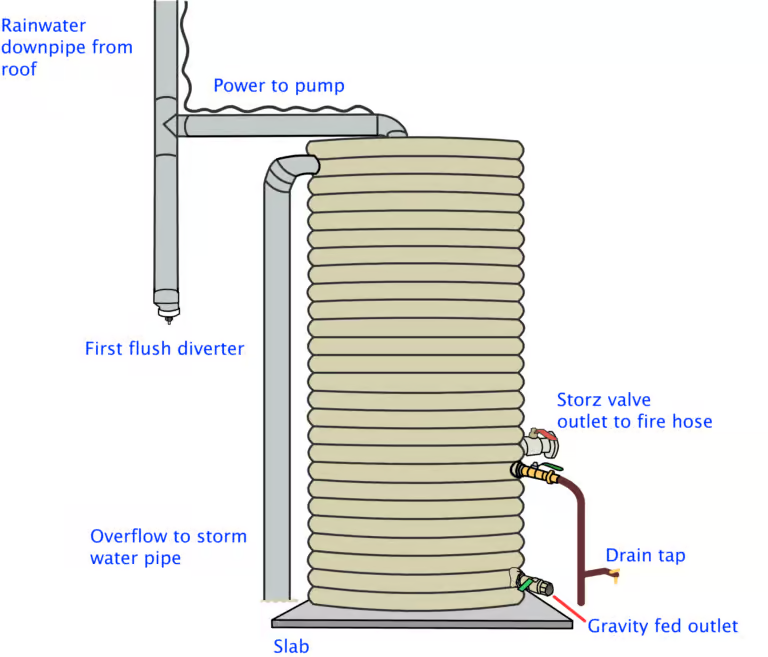
9. The tank must be fitted with a first-flush device with an automatic resetting valve so that initial run-off rainwater bypasses the tank.
10. The tank must be designed to prevent mosquitoes breeding in it.
11. The overflow system must be connected to an existing stormwater drainage or management system that does not pour onto or cause nuisance to adjoining properties. This could include a rain garden, infiltration pit or swale, to help recharge groundwater and further reduce urban runoff volumes.
12. The tank must have a ‘rainwater’ sign.
13. Associated pumps must be housed in a soundproof enclosure.
14. If the tank will interconnect with any system supplying drinking water, installation must include an approved top-up water connection or an auto-switching device to supply drinking water when the tank is empty, and to prevent backflow of rainwater to the drinking water supply, e.g. Acquasaver valve: https://www.acquasaver.com.au/model/2019-3-4-inch-acquasaver/
Installing your tank:
You will need to build a safe and stable base for your tank. The best options are bases made of concrete or boxed compacted crusher dust. “Crusher dust” is available from nursery suppliers and is a mix of small, crushed rock and fines.
The best place for a water tank is close to your house. Rainwater is collected from the roof of your property using a downpipe connected to the tank. The closer to the property, the easier it is to connect your downpipes and the less work you are going to need to start collecting rainwater.
How big should my rainwater tank be?
As a rule of thumb, each square metre of roof space collects around 1 litre of water for every 1mm of rainfall received. Using the calculation of (x) square metres of roof space available for connection to your tank multiplied by the amount of rainfall will help guide your decision.
One simple formula to determine the appropriate size of a water tank is to multiply the average daily water usage by the number of days between rainfalls. Check out Tankulator: a free online calculator https://renew.org.au/resources/tankulator/
Connecting your tank:
We recommend that you hire a licensed plumber who’s experienced with rainwater tank installations. You may also need an electrician to provide a safe power supply for your pump.
Your tank will need plumbing connections to deliver water from your:
Downpipes to your tank
Tank (when it’s overflowing) to the stormwater system
Tank to your pump if you’re using one although not always necessary
Pump to your garden taps, toilets, washing machine, hot water system or household plumbing.
Maintenance for your tank:
To ensure your rainwater harvesting and reuse system continues to function optimally, you will need to perform a few basic maintenance tasks regularly, including cleaning your gutters, inlet screens, first-flush diverters and pump filters.
Alternatively, if retrofitting the tank to an existing building/property, the best approach may be simply to install the largest tank that will fit within the available space and budget.